
Introduction
Cyber threats are evolving at an unprecedented pace. From sophisticated ransomware campaigns to advanced persistent threats (APTs), modern organizations face a cyber security landscape that is more complex than ever before. Traditional security tools generate massive volumes of alerts, overwhelming analysts and increasing the risk of missed threats.
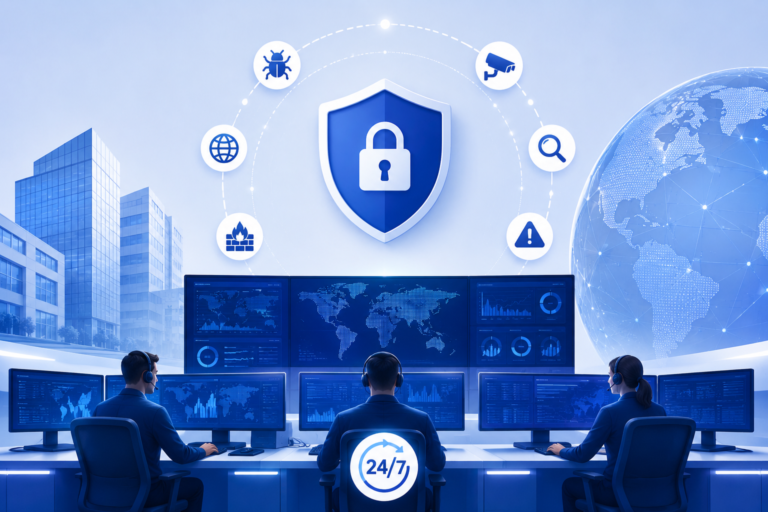
This is where Artificial Intelligence (AI) is creating a significant shift. AI-powered technologies are transforming the modern Security Operations Center (SOC) by enhancing threat detection, accelerating incident response, and improving operational efficiency. For enterprise businesses, AI is no longer a futuristic concept—it has become a critical component of cyber security strategy.
What is AI-Driven Security Operations Center (SOC)?
A Security Operations Center (SOC) is a centralized function responsible for monitoring, detecting, investigating, and responding to cyber security threats across an organization’s digital environment.
An AI-powered Security Operations Center combines machine learning, behavioral analytics, automation, and advanced threat intelligence to identify security risks more accurately and efficiently than traditional methods.
Unlike conventional rule-based systems, AI continuously learns from network activity, user behavior, and threat patterns to improve detection capabilities and reduce false positives.
Why Traditional Security Models Are Failing
Increasing Alert Fatigue
Security teams often receive thousands of alerts every day. Many of these alerts are false positives, making it difficult for analysts to identify genuine threats.
Growing Attack Complexity
Cybercriminals are leveraging automation and AI to launch sophisticated attacks that can bypass traditional defenses.
Skills Shortage
The global shortage of cyber security professionals continues to impact organizations, making it challenging to maintain a fully staffed Security Operations Center.
Delayed Response Times
Manual investigation processes often result in slower detection and response, increasing the potential impact of cyber incidents.
Key Ways AI is Transforming Security Operations Center
AI-Powered Threat Detection
AI can analyze vast amounts of security data in real time to identify anomalies, suspicious behavior, and emerging threats.
Enterprise Impact:
Organizations gain faster visibility into attacks before they cause significant damage.
Automated Incident Response
AI-driven automation can prioritize alerts, trigger response workflows, and isolate compromised systems.
Business Benefit:
Reduced Mean Time to Detect (MTTD) and Mean Time to Respond (MTTR).
Behavioral Analytics
Modern Security Operations Center platforms use AI to establish normal user and device behavior patterns.
Real-World Relevance:
Insider threats and compromised accounts can be detected before unauthorized activities escalate.
Threat Intelligence Correlation
AI correlates threat intelligence feeds with internal security data to identify indicators of compromise.
Enterprise Impact:
Improved threat context and more informed security decisions.
Predictive Security Analytics
AI enables organizations to anticipate potential attack vectors by analyzing historical trends and threat patterns.
Business Benefit:
Proactive risk management rather than reactive defense.
Benefits of AI-Driven Security Operations Center
1. Faster Threat Detection
AI continuously monitors environments and identifies threats in real time.
2. Reduced False Positives
Machine learning improves alert accuracy, allowing analysts to focus on critical incidents.
3. Enhanced Operational Efficiency
Automation eliminates repetitive tasks and improves analyst productivity.
4. Improved Incident Response
AI accelerates investigation and containment activities.
5. Better Compliance Management
Continuous monitoring supports regulatory requirements and audit readiness.
6. Scalable Security Operations
Organizations can manage growing attack surfaces without proportional increases in staffing.
Challenges and Risks of AI in Cyber Security
Data Quality Issues
AI effectiveness depends on accurate and high-quality data.
Adversarial AI Attacks
Attackers may attempt to manipulate AI models or exploit algorithmic weaknesses.
Implementation Complexity
Successful deployment requires skilled personnel, governance frameworks, and integration planning.
Privacy Concerns
Organizations must ensure AI-driven monitoring complies with privacy regulations and internal policies.
Future of AI-Powered Security Operations Center
Autonomous SOC Operations
Future Security Operations Center environments will leverage autonomous threat hunting and response capabilities.
Generative AI for Security Analysis
AI assistants will help analysts investigate incidents and generate actionable recommendations.
Advanced Predictive Defense
AI models will identify vulnerabilities and attack patterns before exploitation occurs.
Hyper-Automation
Organizations will automate larger portions of security workflows and incident management.
AI-Driven Risk Management
Real-time risk scoring will help businesses prioritize remediation efforts more effectively.
Why Businesses Should Adopt AI-Driven Security Solutions
The modern threat landscape demands faster, smarter, and more scalable security capabilities. AI enables organizations to strengthen their Security Operations Center by reducing response times, improving detection accuracy, and optimizing security resources.
For enterprise businesses undergoing digital transformation, AI-powered cyber security provides a strategic advantage. It allows organizations to protect critical assets, maintain compliance, reduce operational risk, and build cyber resilience against emerging threats.
Partnering with a trusted Cyber Security OEM can help organizations deploy AI-driven solutions that align with business objectives and security requirements.
Conclusion
AI is fundamentally transforming the Security Operations Center from a reactive security function into a proactive, intelligence-driven defense capability. By combining advanced analytics, automation, behavioral intelligence, and predictive security, organizations can significantly improve their cyber security posture.
As cyber threats continue to evolve, businesses that invest in AI-driven security today will be better positioned to defend against tomorrow’s challenges. Modernizing the Security Operations Center is no longer optional—it is a strategic necessity for enterprise resilience and long-term business success.
Call-to-Action
Transform Your Security Operations Center with Velox Solutions Pvt. Ltd.
Looking to modernize your cyber security strategy with AI-powered threat detection, SOC automation, and advanced security analytics?
Velox Solutions Pvt. Ltd. helps enterprises build intelligent, scalable, and future-ready Security Operations Center capabilities designed to detect threats faster, reduce operational complexity, and strengthen cyber resilience.
Schedule a personalized demo, speak with our cyber security experts, and discover how AI-driven security solutions can protect your organization from evolving threats.
Contact Velox Solutions Pvt. Ltd. today to begin your Security Operations Center transformation journey.
Frequently Asked Questions
1. What is an AI-powered Security Operations Center?
An AI-powered Security Operations Center uses machine learning, automation, and analytics to improve threat detection, investigation, and response capabilities.
2. How does AI improve cyber security?
AI enhances cyber security by identifying anomalies, automating workflows, reducing false positives, and accelerating incident response.
3. Can AI replace SOC analysts?
No. AI augments SOC analysts by handling repetitive tasks and providing actionable insights, allowing analysts to focus on complex investigations.
4. What are the benefits of AI in a Security Operations Center?
Benefits include faster detection, improved efficiency, reduced false positives, better compliance, enhanced scalability, and stronger cyber resilience.
5. Is AI cyber security suitable for enterprises?
Yes. Enterprise organizations benefit significantly from AI-driven Security Operations Center capabilities due to their large and complex IT environments.
6. What challenges are associated with AI security solutions?
Challenges include data quality requirements, implementation complexity, privacy considerations, and adversarial AI risks.
7. How does AI support SOC automation?
AI automates alert prioritization, threat analysis, incident response workflows, and security investigations.
8. Why should organizations modernize their Security Operations Center?
Modernization helps organizations address evolving threats, reduce operational burdens, improve detection accuracy, and strengthen overall cyber security posture.